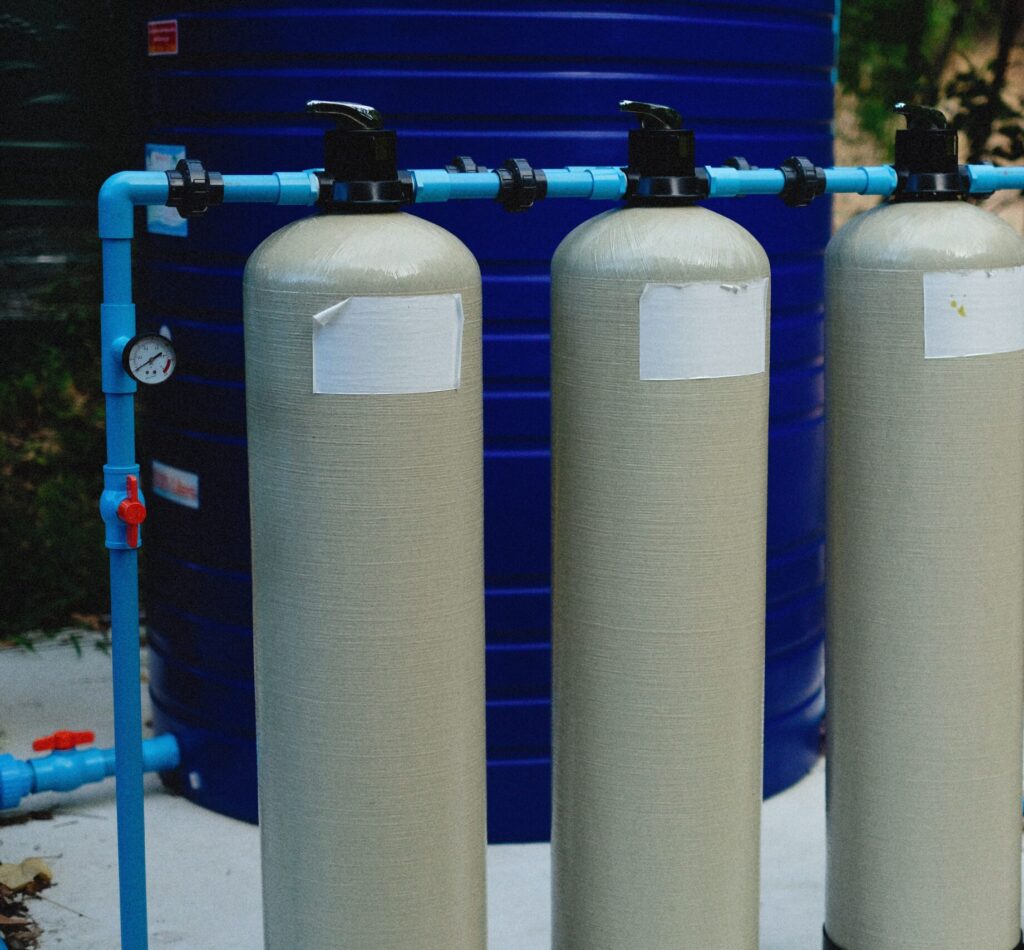
A decrease in cation exchange capacity within a Cation Exchanger unit (whether in Demineralization Plants or Water Softeners) often presents a serious operational challenge in industrial water treatment. One of the primary causes of this issue is organic fouling (clogging caused by organic compounds).
When organic molecules become trapped within the pores of the resin matrix, access for target ions to strong acid functional groups (such as sulfonic acid) is blocked. Consequently, service run durations shorten, chemical regenerant consumption increases, and product water quality drops significantly.
Organic fouling on cation resin is commonly driven by the presence of Natural Organic Matter (NOM) such as humic acid, fulvic acid, oils, grease, and dissolved organic polymer contaminants in the raw water.
The degradation mechanism typically involves two main stages:
Before applying corrective measures, perform field verification against the following technical indicators:
| Parameter Indicator | Observed Symptom | Root Cause |
|---|---|---|
| Throughput Volume | Drastic decrease in purified water volume per cycle | Reduced effective exchange capacity of functional groups |
| Cation Leakage | Premature Sodium (Na+) or Hardness leakage | Cation exchange blocked by organic surface film |
| Pressure Drop (ΔP) | Increased differential pressure (head loss) across the bed | Accumulation of deposits and trapped debris in the bed |
| Resin Bead Appearance | Darker, dull, or sticky appearance during sampling | Organic film layer covering the bead surfaces |
To restore the operational capacity of cation resin affected by organic fouling, periodic chemical cleaning (Cleaning in Place / CIP) must be conducted systematically:
Perform a backwash at a calculated flow rate (50–75% bed expansion) for 15–30 minutes. This step loosens the compacted resin bed and flushes out physically trapped suspended solids before chemical treatment begins.
Routine cleaning using acid alone is ineffective for stripping organic foulants. The industry-standard method strongly recommends a combination of Alkali and Salt (NaOH + NaCl):
If the fouling is caused by oil or surfactants, add a specialized low-foaming non-ionic surfactant designed for resin beds to the alkaline cleaning solution at a concentration of 0.1%.
Following the completion of chemical cleaning and neutral rinsing, the cation resin must be regenerated using an acid regenerant (HCl 4–5% or stepwise H2SO4) at double the standard dosage. This step is critical to fully convert the resin back into its active Hydrogen (H+) or Sodium (Na+) ionic form.
Prevention is always more economical than repeated chemical cleaning. Ensure your raw water pretreatment system includes:
Blog Learning Causes of Sub-Optimal Chemical Dosing in Water…
Blog Learning Optimizing Industrial Flocculation with TFI Chemical Optimizing…
Blog Learning About WTP/WWTP Coagulants with TFI Chemical Selecting…
Blog How to Handle Industrial RO Issues with TFI…