
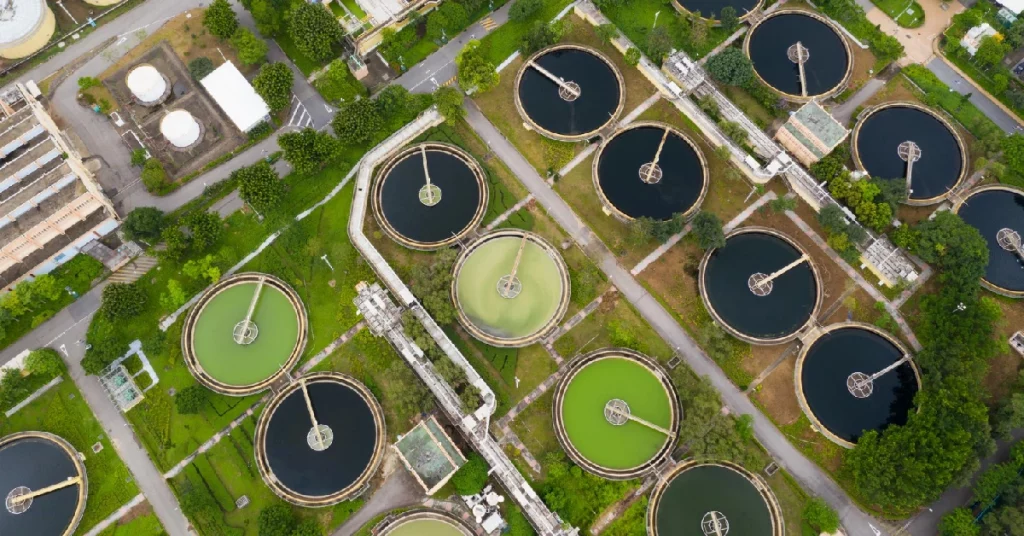
An overview of chemical mechanisms, wastewater conditions, the limitations of conventional processes, and treatment strategies for effectively reducing Pb and sulfate.
Lead (Pb) and sulfate (SO₄²⁻) can be difficult to reduce to wastewater quality targets, but for different reasons. Pb is a heavy metal that may occur as dissolved ions, bind to organic matter, or attach to fine particles. Sulfate, by contrast, is an anion that is generally highly soluble in water and remains in the dissolved phase under many conventional treatment conditions.
Conventional coagulation, flocculation, sedimentation, and filtration are primarily effective for suspended particles and certain contaminants that can precipitate or bind to flocs. These processes do not automatically remove dissolved ions. Therefore, treatment performance for Pb and sulfate depends on their chemical forms, pH, wastewater composition, reagent selection, and solids separation after the reaction.
This article discusses the mechanisms that make these two parameters persistent and treatment approaches that may be considered based on wastewater characteristics and laboratory test results.
Pb may be present as dissolved ions, complexes with organic or inorganic compounds, or as part of particles and colloids. Precipitation is effective only when chemical conditions support the formation of sufficiently stable solids and those solids are actually separated.
Pb can precipitate as a hydroxide when the pH is raised to a suitable range. However, no single pH value is optimal for every wastewater. At too low a pH, Pb may remain dissolved; under certain conditions, an excessively high pH can also increase solubility again by forming dissolved hydroxy species.
Operational implication: pH should be controlled and evaluated alongside alkalinity, ionic composition, and wastewater characteristics. After precipitation, flocs or precipitates must be separated by sedimentation, filtration, or another suitable separation technology.
Hardness, carbonate, chloride, organic matter, and other metals can alter Pb speciation and reagent demand. Inappropriate chemical dosing or poor mixing can produce fine precipitates that are difficult to separate. Pb is not destroyed during treatment; much of it is transferred to sludge. Therefore, Pb-containing sludge must be handled and tested in accordance with applicable regulations.
Sulfate is a stable inorganic ion with high solubility. The coagulation-flocculation processes commonly used to remove suspended solids do not directly convert dissolved sulfate into solids. As a result, treated water may look clear while its sulfate concentration remains high.
Sulfate can be precipitated using certain ions, such as barium, but barium use requires careful evaluation because of toxicity, cost, and residual risks. Lime-based processes at high pH can reduce sulfate through the formation of certain minerals, such as ettringite, but performance depends on water composition, reagent dose, pH, reaction time, and sludge production.
Operational implication: method selection should consider the initial concentration and final target, ionic composition, chemical requirements, sludge quantity, and residuals-management costs.
If chemical precipitation is uneconomical or does not meet the target, technologies such as reverse osmosis (RO), nanofiltration, or ion exchange may be considered. Membrane technologies transfer sulfate into a concentrate stream that still requires management; ion exchange requires resin regeneration and handling of the regenerant solution. Biological sulfate reduction can also be used under controlled conditions, but sulfide formation, electron-donor requirements, and downstream treatment must be considered.
| Parameter | Why Is It Difficult to Remove? | Treatment Focus |
|---|---|---|
| Pb | Speciation varies; Pb may be dissolved, complexed, or present in fine colloids. Precipitation is sensitive to pH and the wastewater matrix. | Adjust pH and reagents based on testing, promote floc formation when needed, then separate the precipitate and manage the sludge. |
| Sulfat | Highly soluble and generally not removed by conventional coagulation. | Consider specialized precipitation, membranes, ion exchange, or biological reduction based on the target and wastewater characteristics. |
| Both | Flow and composition variations, incorrect dosing, inadequate mixing, and ineffective solids separation. | Wastewater characterization, laboratory-scale testing, routine monitoring, and residuals management. |
Monitor pH, dosing, contact time, mixing, influent and effluent concentrations, and the performance of separation units. Also assess sludge, spent media, resin, and membrane concentrate because contaminants are not necessarily destroyed; they are often transferred to residual streams that require safe management in accordance with regulations.
Pb and sulfate are difficult to remove because they behave differently chemically. For Pb, the main challenges are changes in chemical form, complex formation, pH sensitivity, and the need to separate precipitates effectively. For sulfate, the main challenge is its high solubility, which allows it to remain in the water after conventional treatment.
A reliable solution begins with wastewater characterization, laboratory testing, selection of an appropriate process, and effluent monitoring. Performance should be evaluated based on measured Pb and sulfate concentrations and proper residuals management, not merely on the clarity of the treated water.
The pH range, reagent dose, and final treatment technology should be established through tests representative of the actual wastewater. Avoid setting doses or operating conditions based solely on estimates without laboratory verification.
Blog Learning Causes about Lead (Pb) and Sulfate (SO₄²⁻)…
Blog Learning Causes of Sub-Optimal Chemical Dosing in Water…
Blog Learning Optimizing Industrial Flocculation with TFI Chemical Optimizing…
Blog Learning About WTP/WWTP Coagulants with TFI Chemical Selecting…